
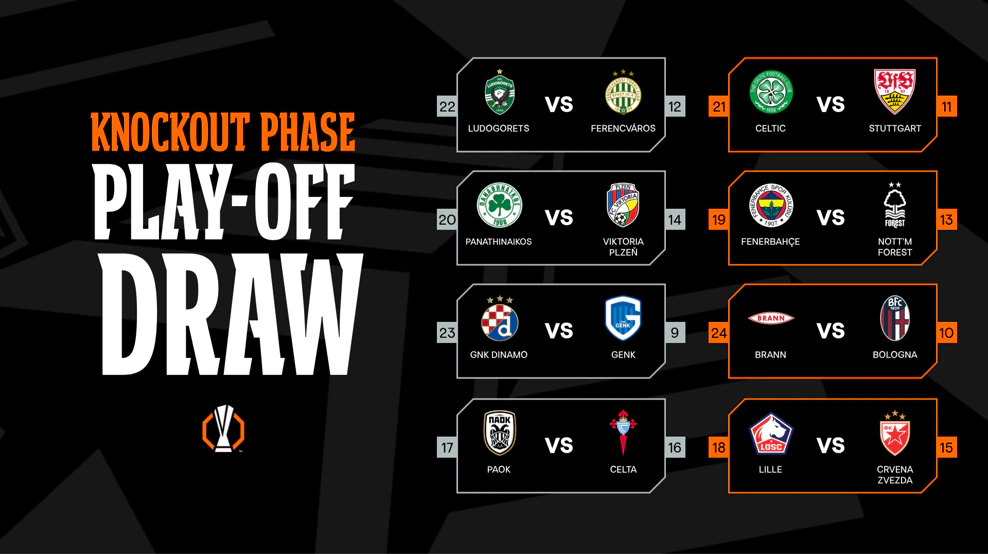
With the league phase complete, the 2025/26 UEFA Europa League is down to 24 contenders. This guide explains who qualified directly for the Round of 16, who must survive the knockout phase play-offs, and what the key storylines are as the tournament’s business end begins — with kick-off times also shown for Indonesia (WIB).
The Europa League is now in knockout mode
The race to win the Europa League is heating up with 24 teams remaining following the conclusion of the league phase. From here, the format is straightforward:
- The top eight in the league phase advance directly to the Round of 16
- Teams finishing 9th to 24th enter the knockout phase play-offs
- The play-offs are two-legged ties; winners join the top eight in the Round of 16
If you’re tracking fixtures from Indonesia, note the time conversion:
- 21:00 CET = 03:00 WIB (next day)
- 18:45 CET = 00:45 WIB (next day)
At a glance: who’s in, who’s out
Confirmed in the Round of 16
Aston Villa (ENG), Braga (POR), Freiburg (GER), Lyon (FRA), Midtjylland (DEN), Porto (POR), Real Betis (ESP), Roma (ITA)
Confirmed in the knockout phase play-offs
Bologna (ITA), Brann (NOR), Celta Vigo (ESP), Celtic (SCO), Crvena Zvezda (SRB), Fenerbahçe (TUR), Ferencváros (HUN), Genk (BEL), GNK Dinamo (CRO), Lille (FRA), Ludogorets (BUL), Nottingham Forest (ENG), Panathinaikos (GRE), PAOK (GRE), Stuttgart (GER), Viktoria Plzeň (CZE)
Eliminated after the league phase
Basel (SUI), FCSB (ROU), Feyenoord (NED), Go Ahead Eagles (NED), Maccabi Tel Aviv (ISR), Malmö (SWE), Nice (FRA), Rangers (SCO), Salzburg (AUT), Sturm Graz (AUT), Utrecht (NED), Young Boys (SUI)
Key dates for the knockout phase (CET + WIB)
- Knockout phase play-offs: 19 & 26 February 2026
(typical kick-off 21:00 CET / 03:00 WIB, unless stated) - Round of 16: 12 & 19 March 2026
- Quarter-finals: 9 & 16 April 2026
- Semi-finals: 30 April & 7 May 2026
- Final: 20 May 2026 (Istanbul)
Round of 16 teams: why they matter
Below are the eight clubs that earned a direct path to the last 16. UEFA coefficient rankings are stated as accurate as of the league phase draw (per your dataset).
Aston Villa (ENG)
UEFA coefficient ranking: 28
How they qualified: Sixth in England
Last season: Champions League quarter-finals (L 4–5 agg vs Paris)
League phase position: 2
Best UEFA Cup/Europa League performance: Quarter-finals (1977/78, 1997/98)
Villa’s league phase was elite-level: they finished level on 21 points with Lyon at the top. The bigger story, though, is the manager: Unai Emery’s Europa League record is unmatched in the modern era, and his teams tend to improve as knockout pressure rises. Villa have historically fallen short of the final stages in this competition, but their recent European trajectory suggests a higher ceiling than the club’s Europa League archive implies.
Braga (POR)
UEFA coefficient ranking: 44
How they qualified: Qualifying play-offs
Last season: League phase (25/36)
League phase position: 6
Best Europa League performance: Runners-up (2010/11)
Braga are one of the most stable “upper-middle” European clubs: tactically disciplined, hard to blow away, and comfortable in two-legged football. Their 2011 run remains the reference point, but the 2025/26 league phase finish shows a team that can win in multiple ways — especially when the match turns into a contest of patience rather than chaos.
Freiburg (GER)
UEFA coefficient ranking: 56
How they qualified: Fifth in Germany
Last season: Not in European competition
League phase position: 7
Best Europa League performance: Round of 16 (2022/23, 2023/24)
Freiburg’s reputation is built on cohesion and coaching continuity. That matters in knockout football, where “systems” frequently beat “names.” Their league phase record (five wins, two draws) was the profile of a side that limits mistakes. If they avoid early red-card or set-piece swings, they’re the type of opponent nobody wants in March.
Lyon (FRA)
UEFA coefficient ranking: 31
How they qualified: Sixth in France
Last season: Quarter-finals (L 6–7 agg vs Manchester United)
League phase position: 1
Best Europa League performance: Semi-finals (2016/17)
Top of the league phase table, Lyon look like the tournament’s most complete team. Their best Europa League run came in 2016/17, and they’ve repeatedly shown they can handle European rhythm. Finishing first also signals a side that can win away from home and handle different match states — the most transferable traits when the ties get tight.
Midtjylland (DEN)
UEFA coefficient ranking: 55
How they qualified: Qualifying play-offs
Last season: Knockout phase play-offs (L 3–7 agg vs Real Sociedad)
League phase position: 3
Best Europa League performance: Round of 32 (2015/16); Knockout phase play-offs (2022/23, 2024/25)
Midtjylland’s story is modern European football done well: clear recruitment logic, clear tactical identity, and excellent home performances. Their league phase finish (third) earned the reward of skipping the play-offs — a big edge in February when squads are managing injuries and domestic schedules.
Porto (POR)
UEFA coefficient ranking: 21
How they qualified: Third in Portugal
Last season: Knockout phase play-offs (L 3–4 agg vs Roma)
League phase position: 5
Best Europa League performance: Winners (2002/03, 2010/11)
Porto are one of the most “knockout-ready” clubs in the competition. Their European identity is built on managing moments: protecting leads, winning tactical battles, and turning tight ties with set pieces and transitions. A decisive league phase finish (including a 3–1 win vs Rangers) underlined the core Porto trait: showing up when the stakes rise.
Real Betis (ESP)
UEFA coefficient ranking: 25
How they qualified: Sixth in Spain
Last season: Conference League runners-up (L 1–4 vs Chelsea)
League phase position: 4
Best Europa League performance: Round of 16 (multiple seasons)
Betis come into this knockouts phase with fresh experience of European finals pressure from last season. Their upside is technical quality and game control; their risk is the volatility that can appear when matches become emotional or chaotic. If they keep ties structured, they can go deep.
Roma (ITA)
UEFA coefficient ranking: 12
How they qualified: Fifth in Italy
Last season: Europa League quarter-finals (L 3–4 vs Athletic Club)
League phase position: 8
Best Europa League performance: Runners-up (1990/91, 2022/23)
Roma are built for two-legged football: pragmatic control, situational defending, and enough individual talent to decide moments. Their badge and identity are steeped in Rome’s mythology, but the modern Roma story is about European consistency — including a runners-up finish in 2022/23. They won’t be a stylistic favorite, but they are a strategic threat.
Knockout phase play-offs: the 16 teams who still have work to do
The play-offs are where form, squad depth, and match management collide. One mistake can swing 180 minutes.
Bologna (ITA)
UEFA coefficient ranking: 80
Play-off opponents: Brann
How they qualified: Cup winners in Italy
Last season: Champions League league phase (28/36)
League phase position: 10
Best Europa League performance: Semi-finals (1998/99)
Bologna bring a compelling blend of momentum and narrative: Champions League exposure last season, then a historic domestic cup win. In knockout ties, their advantage is intensity at home and the emotional lift of a stadium that doesn’t see European knockouts every year.
Brann (NOR)
UEFA coefficient ranking: 139
Play-off opponents: Bologna
How they qualified: Qualifying play-offs
Last season: Conference League qualifying play-offs (L 2–3 agg vs Astana)
League phase position: 24
Best Europa League performance: Round of 32 (2007/08)
Brann qualified in the last available slot, which often creates a “nothing to lose” energy. Their story includes a rapid domestic rebound and a convincing qualification run. For underdogs, the key is making the tie messy and keeping the first leg alive.
Celta Vigo (ESP)
UEFA coefficient ranking: 104
Play-off opponents: PAOK
How they qualified: Seventh in Spain
Last season: Not in Europe
League phase position: 16
Best Europa League performance: Semi-finals (2016/17)
Celta’s ceiling is real: their 2016/17 semi-final run is proof they can go deep when the squad clicks. They’re a tricky opponent because they don’t play like a typical mid-tier Spanish side; when transitions open up, they can be ruthless.
Celtic (SCO)
UEFA coefficient ranking: 58
Play-off opponents: Stuttgart
How they qualified: Champions League qualifying play-offs
Last season: Champions League knockout play-offs (L 2–3 agg vs Bayern)
League phase position: 21
Best Europa League performance: Runners-up (2002/03)
Celtic’s home atmosphere is a strategic advantage, not a cliché. Their 2003 final run still shapes club identity, and the modern squad tends to rise with crowd energy. Their challenge is controlling away legs, where European ties often slip.
Crvena Zvezda (SRB)
UEFA coefficient ranking: 53
Play-off opponents: Lille
How they qualified: Champions League qualifying play-offs
Last season: Champions League league phase (29/36)
League phase position: 15
Best Europa League performance: Runners-up (1978/79)
European Cup winners in 1991 and UEFA Cup finalists in 1978/79, Crvena Zvezda carry genuine European tradition. They can be a nightmare in a tight tie: set pieces, intensity, and belief. The key question is whether they can translate home force into away stability.
Fenerbahçe (TUR)
UEFA coefficient ranking: 40
Play-off opponents: Nottingham Forest
How they qualified: Champions League qualifying play-offs
Last season: Round of 16 (L 3–3 agg, 2–3 pens vs Rangers)
League phase position: 19
Best Europa League performance: Semi-finals (2012/13)
Fenerbahçe are built for knockout emotional environments. Their best modern run was 2012/13, and the current squad profile suggests they can win “moment” games. Their edge is home intensity; their risk is discipline in the second leg.
Ferencváros (HUN)
UEFA coefficient ranking: 50
Play-off opponents: Ludogorets
How they qualified: Champions League qualifying play-offs
Last season: Knockout phase play-offs (L 1–3 agg vs Viktoria Plzeň)
League phase position: 12
Best Europa League performance: Semi-finals (1971/72)
Ferencváros dropped into the play-offs after falling out of the top eight late. They often look strongest when playing proactive football at home — the danger is when a tie becomes reactive and conservative. Against Ludogorets, margins could come down to set pieces and game-state management.
Genk (BEL)
UEFA coefficient ranking: 79
Play-off opponents: GNK Dinamo
How they qualified: Qualifying play-offs
Last season: Not in Europe
League phase position: 9
Best Europa League performance: Quarter-finals (2016/17)
Genk narrowly missed direct qualification, which usually means they were one or two moments away from a very different path. Their 2016/17 quarter-final run shows they can handle Europe. The tie vs Dinamo looks one of the most balanced on paper.
GNK Dinamo (CRO)
UEFA coefficient ranking: 54
Play-off opponents: Genk
How they qualified: Second in Croatia
Last season: Champions League league phase (25/36)
League phase position: 23
Best Europa League performance: Quarter-finals (2020/21)
Dinamo’s European tradition predates modern UEFA competitions, and they’ve consistently produced players capable of deciding ties. Their league phase points total kept them inside the cut line; now the question is whether their away performances can match their home identity.
Lille (FRA)
UEFA coefficient ranking: 29
Play-off opponents: Crvena Zvezda
How they qualified: Fifth in France
Last season: Champions League Round of 16 (L 2–3 agg vs Dortmund)
League phase position: 18
Best Europa League performance: Round of 16 (multiple seasons)
Lille’s strength is adaptability. They can play possession, they can press, and they can sit deep and counter — useful traits in a two-legged tie. Their weakness historically has been converting dominance into goals when ties get tight.
Ludogorets (BUL)
UEFA coefficient ranking: 74
Play-off opponents: Ferencváros
How they qualified: Qualifying play-offs
Last season: League phase (33/36)
League phase position: 22
Best Europa League performance: Round of 16 (2013/14)
Domestic dominance doesn’t always translate in Europe, but Ludogorets have enough continental experience to avoid being overwhelmed by the moment. Their key is defensive concentration: one lapse can undo 70 minutes of good work.
Nottingham Forest (ENG)
UEFA coefficient ranking: 85
Play-off opponents: Fenerbahçe
How they qualified: Seventh in England
Last season: Not in Europe
League phase position: 13
Best Europa League performance: Semi-finals (1983/84)
Forest’s history is elite, but modern European experience is minimal — which can be both a downside and a motivator. Their emphatic final league phase result signaled confidence. Against Fenerbahçe, the tie may turn on whether Forest can keep emotional control in Istanbul.
Panathinaikos (GRE)
UEFA coefficient ranking: 78
Play-off opponents: Viktoria Plzeň
How they qualified: Qualifying play-offs
Last season: Conference League Round of 16 (L 4–5 agg vs Fiorentina)
League phase position: 20
Best Europa League performance: Quarter-finals (1987/88, 2002/03)
Panathinaikos bring big-club identity and a strong domestic trophy record. In Europe, their advantage is resilience — they tend to stay in games. Their biggest challenge is chance creation against well-drilled opponents.
PAOK (GRE)
UEFA coefficient ranking: 51
Play-off opponents: Celta Vigo
How they qualified: Qualifying play-offs
Last season: Knockout phase play-offs (L 1–4 agg vs FCSB)
League phase position: 17
Best Europa League performance: Round of 32 / play-offs (multiple seasons)
PAOK’s profile is clear: intensity, direct attacking sequences, and a team identity shaped by their historical roots. They scored 17 goals in the league phase, which signals real threat, but they’ll need defensive control to contain Celta’s transitional moments.
Stuttgart (GER)
UEFA coefficient ranking: 77
Play-off opponents: Celtic
How they qualified: Cup winners in Germany
Last season: Champions League league phase (26/36)
League phase position: 11
Best Europa League performance: Runners-up (1988/89)
Stuttgart are structured and dangerous, and they missed direct qualification by a thin margin. Their historical European finals pedigree adds credibility, but the Celtic tie will likely come down to how they manage the atmosphere away and whether they can control the tempo.
Viktoria Plzeň (CZE)
UEFA coefficient ranking: 47
Play-off opponents: Panathinaikos
How they qualified: Champions League third qualifying round
Last season: Round of 16 (L 2–3 agg vs Lazio)
League phase position: 14
Best Europa League performance: Round of 16 (multiple seasons)
Plzeň are a classic European “system” team: organized, patient, and difficult to destabilize. In play-offs, that reliability is valuable. Their path often hinges on first-leg control: avoid conceding first, keep the tie on their terms.
What to watch in the play-offs
Tie management matters more than style
In February, teams are rarely at physical peak. The sides that progress are often those that:
- control transitions
- avoid disciplinary chaos
- manage game states (leading vs chasing)
- take set-piece chances efficiently
Home advantage is real
Some venues in this round can swing a tie by themselves. If you’re projecting outcomes, factor in the “home leg effect” rather than treating both matches as equal.
Quick reference: Europa League knockout timeline (CET + WIB)
- Knockout phase play-offs: 19 & 26 February 2026
(commonly 21:00 CET / 03:00 WIB, unless stated) - Round of 16: 12 & 19 March 2026
- Quarter-finals: 9 & 16 April 2026
- Semi-finals: 30 April & 7 May 2026
- Final: 20 May 2026 (Istanbul)
Where to follow the competition on Europaleaguein
For the latest match outcomes, aggregates, and updated tables, head to our Results page.
For squad updates, injury news, and tactical previews, visit our Europa League News section.