
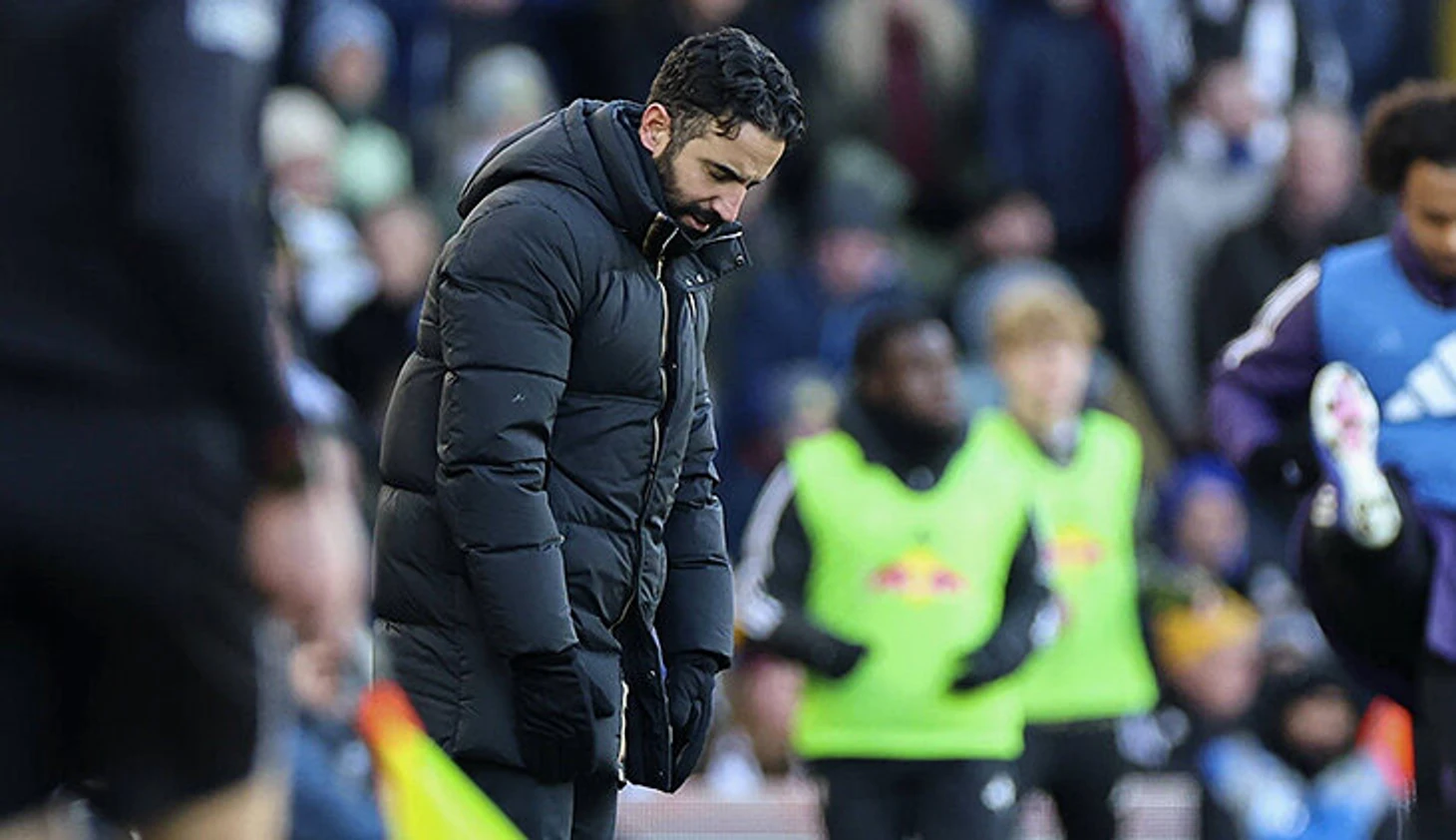
Manchester United have officially dismissed head coach Ruben Amorim, bringing an abrupt end to a turbulent spell marked by internal disagreements, tactical rigidity, and growing frustration on both sides. The decision was communicated to the Portuguese coach on Monday morning by sporting director Jason Wilcox and CEO Omar Berrada at the club’s Carrington training base.
According to multiple reliable English sources, including David Ornstein, the dismissal followed a prolonged breakdown in relations between Amorim and the club’s hierarchy. United have no plans to appoint a permanent successor mid-season, with Darren Fletcher stepping in as interim head coach while the search is postponed until the summer.
How the Situation Escalated Behind the Scenes
The tension surrounding Amorim had been building for weeks, but it became public after a volatile press conference following a 1–1 draw against Leeds United. When questioned about his future, Amorim delivered an unusually defiant response, stressing that he saw himself not merely as a coach, but as a manager with broader authority.
He openly criticised internal processes, insisted that all departments must “do their jobs,” and suggested that media narratives were selectively shaped. Several journalists present described the moment as a clear signal that Amorim wanted significantly more influence within the club’s decision-making structure.
That message was echoed by Fabrizio Romano, who interpreted the comments as a demand for greater control rather than a routine media outburst. James Ducker of The Telegraph went further, describing the episode as an ultimatum that left United with a binary choice: back Amorim fully, or remove him.
United opted for the latter.
“Head Coach,” Not Manager: A Crucial Distinction
One of the key misunderstandings revolved around Amorim’s role. When he was appointed, Manchester United deliberately used the title “head coach” — a distinction that had not been applied since the departure of Sir Alex Ferguson. Internally, this was intended to signal a modernised structure where recruitment and long-term strategy sit firmly above the coaching staff.
Amorim, however, appeared to believe he had been hired with broader managerial authority, similar to Erik ten Hag, who previously held veto power over transfers and exerted heavy influence on squad planning. That level of control was never extended to Amorim.
The club even underlined this distinction in its dismissal statement, carefully referring to him as “head coach” rather than “manager” — a subtle but telling detail.
Transfer Frustrations and Broken Expectations
Recruitment issues further strained the relationship. During the summer, United identified the need for a goalkeeper and a centre-forward. Amorim reportedly pushed for Emiliano Martínez and Viktor Gyökeres, but the club instead invested in younger profiles such as Senne Lammens and Benjamin Šeško.
January brought additional frustration. United explored a move for Bournemouth winger Antoine Semenyo, but the player chose Manchester City. Amorim expected the allocated budget — reportedly around £65 million — to be redirected elsewhere. That never happened.
With multiple injuries mounting and several players absent due to the Africa Cup of Nations, Amorim publicly stated that January signings were not even being discussed internally. Behind the scenes, his relationship with Jason Wilcox deteriorated noticeably, according to reports from Nathan Salt and Reuters.
INEOS, the club’s new football leadership, remained firm: no short-term or panic signings, only long-term targets. From the club’s perspective, Amorim had been aware of this policy from the outset.
Tactical Rigidity and the 3-4-3 Problem
Beyond transfers, tactics became a decisive fault line. United’s leadership increasingly questioned Amorim’s commitment to a 3-4-3 system that many felt exposed the team, particularly in midfield. Sporting director Jason Wilcox had expected greater adaptability, especially given the squad’s profile.
Several insiders revealed that United were open to shifting toward a back four, even planning recruitment accordingly. Amorim, however, repeatedly returned to his preferred system under pressure — a pattern that frustrated both executives and players.
There were brief experiments with a 4-2-3-1 formation against Bournemouth and Newcastle, but crucial matches later saw a return to 3-4-3. Internally, this was interpreted as a lack of confidence rather than conviction.
According to Sky Sports, the issue was not the formation itself, but Amorim’s reluctance to adjust based on opponents and circumstances.
The Leeds Match: A Silent Protest
The draw against Leeds became symbolic of the wider breakdown. Amorim made only one substitution despite a thin bench and visible fatigue across the team. Observers interpreted this as a quiet protest against the lack of squad depth and recruitment support.
By that stage, sources suggest the decision had effectively already been made.
Amorim’s Perspective: “Painful” but Unwanted Exit
While Amorim has not spoken publicly since his dismissal, Sky Sports reports that those close to him describe the decision as deeply painful. Despite his confrontational press conferences, he did not want to leave and genuinely believed United could still finish in a Champions League position under his leadership.
He acknowledged shortcomings in results — just three wins in 11 matches and a 38.1% win rate overall — but remained convinced that additional backing would have transformed the season both sporting- and financially.
The club, however, never shared that assessment and refused to gamble further.
Why the Decision Was Made Before Leeds
Multiple outlets, including The Telegraph and Daily Mail, report that the decisive meeting took place before the Leeds match. When tactical discussions once again turned heated, United’s leadership concluded that the relationship had reached a point of no return.
INEOS executives felt Amorim had provided clarity during a difficult transition period, but ultimately failed to deliver the next phase: development, flexibility, and cohesion.
Financial Cost and Structural Reset
Terminating Amorim’s contract is expected to cost United over £10 million, with total expenses — including compensation to Sporting CP — estimated between £25–30 million.
Yet the club appears willing to absorb the loss as part of a broader structural reset. Going forward, United intend to employ head coaches only, with recruitment and strategic authority firmly centralised. The era of managerial vetoes is over.
Christopher Vivell is expected to take on a more prominent role in shaping both the next appointment and squad evolution.
What Comes Next: Interim Plans and Long-Term Candidates
Darren Fletcher has assumed interim duties and is expected to revert to a 4-3-3 system. He may remain in charge until summer, though some reports suggest another short-term appointment could follow.
As for the permanent role, names already circulating include Oliver Glasner, Roberto De Zerbi, Andoni Iraola, Enzo Maresca, and Kieran McKenna. There have also been speculative links to Ole Gunnar Solskjær and Gareth Southgate, though no option appears imminent.
For now, Manchester United are once again in transition — searching not just for a new coach, but for stability, identity, and alignment at the top.